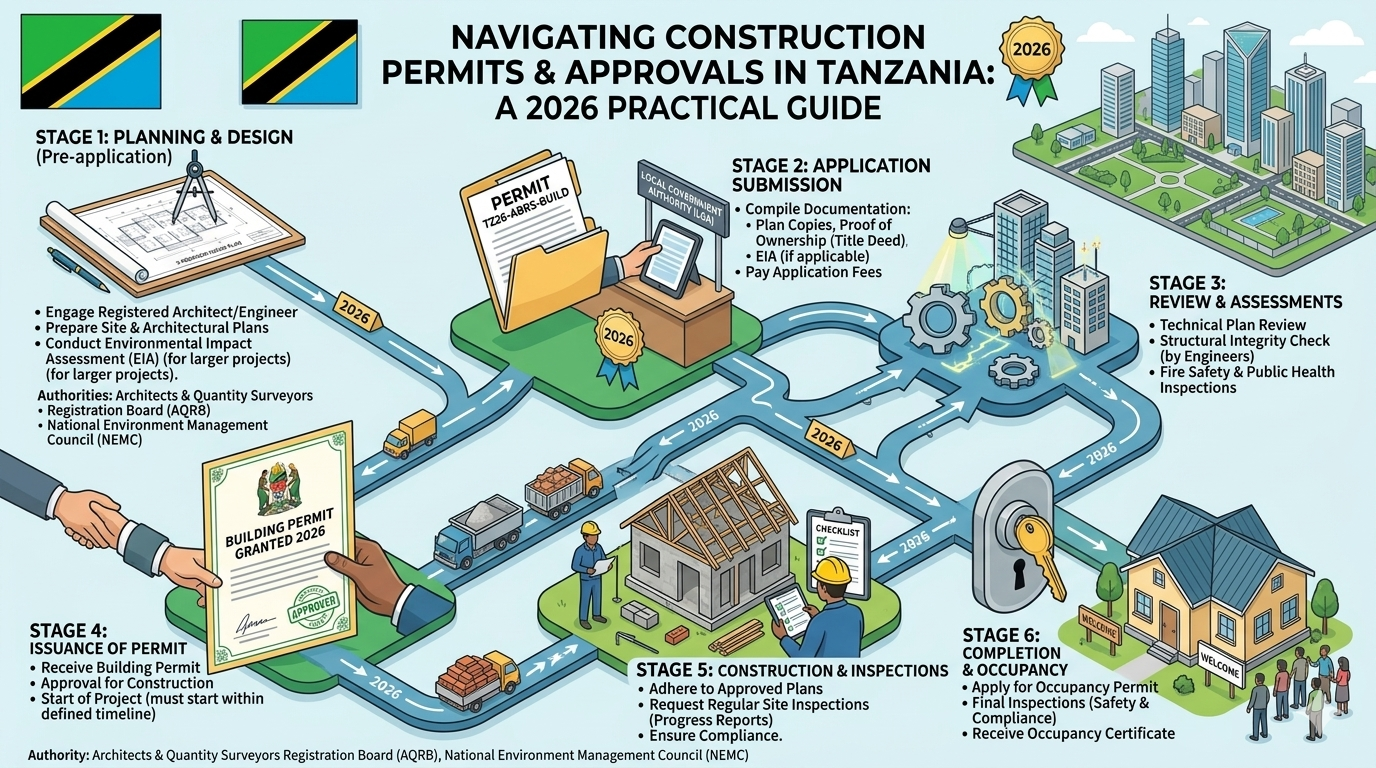
If you're a contractor operating in Tanzania and you want to bid on government tenders or work with serious private clients, CRB registration in Tanzania is not optional — it's a legal requirement. The Contractors Registration Board (CRB) is the statutory body that classifies and licenses contractors across all categories of construction work in the country. Without a valid CRB certificate, you're locked out of the formal market.
This guide walks you through the registration process step by step: who needs to register, the contractor classes available, the documents you'll need, the fees involved, and the common pitfalls that delay or derail applications.
Who Needs to Register with the CRB?
Any individual, firm, or company that undertakes construction works in Tanzania for reward is required to be registered with the CRB under the Contractors Registration Act. This includes:
- General building contractors
- Civil engineering contractors
- Specialist contractors (electrical, mechanical, plumbing, road works, etc.)
- Foreign firms tendering for works in Tanzania
If you're a subcontractor working under a registered main contractor on a private project, you may operate without your own registration — but the moment you want to bid independently or be listed on a tender, you need your own CRB certificate.
CRB Contractor Classes: Which One Do You Qualify For?
The CRB classifies contractors into classes (typically Class I through Class VII for most categories, with Class I being the highest). Your class determines the maximum contract value you're eligible to bid on. Classification is based on:
- Financial capacity — audited accounts, bank statements, and working capital
- Technical capacity — qualifications and experience of key personnel
- Equipment and plant — owned or leased machinery relevant to your works category
- Track record — completed projects with supporting references or contracts
New entrants with limited track record typically qualify for the lower classes (Class V–VII). This isn't a barrier — it's a starting point. Many contractors build their classification over time by completing projects, growing their asset base, and re-applying for upgrading.
Documents You'll Need to Prepare
Gathering your documents before you begin the online application will save you significant time. The CRB requires, at minimum:
- Certificate of Incorporation (for companies) or business licence (for sole traders/partnerships)
- Memorandum and Articles of Association
- TIN (Tax Identification Number) certificate
- Audited financial statements for the most recent financial year(s)
- Bank reference letter and recent bank statements
- CVs and certified copies of academic/professional certificates for key technical staff
- List of plant and equipment (with ownership documents or lease agreements)
- List of completed projects with reference letters or contract documents
- Passport photos and national IDs for directors/partners
For specialist categories, additional technical evidence may be required — for example, electrical contractors may need to show staff with relevant TANESCO or EWURA-recognised credentials.
The CRB Registration Process: Step by Step
Step 1: Create an Account on the CRB Online Portal
The CRB processes applications through its online system. Go to the CRB Tanzania official website and register your firm as a new applicant. Keep your login credentials safe — you'll return to this portal for renewals and upgrades.
Step 2: Complete the Application Form
Fill in all sections of the online form accurately. Errors or inconsistencies between your form and your supporting documents are the single most common reason applications are delayed or rejected. Double-check company names, TIN numbers, and director details against your official documents before submitting.
Step 3: Upload Supporting Documents
Scan and upload all required documents in the formats specified by the portal. Blurry scans, missing pages, or documents in unsupported formats will stall your application at the verification stage.
Step 4: Pay the Application Fee
Application and registration fees vary by contractor class and category. The CRB publishes its current fee schedule on its official website — check there directly for the latest figures, as fees are revised periodically. Payment is typically made via bank transfer or mobile money to the CRB's designated account, with proof of payment uploaded to the portal.
Step 5: Attend an Inspection or Interview (if required)
For higher contractor classes, or where the Board has queries about your application, you may be called in for a site inspection of your equipment or an interview with the registration committee. Prepare to demonstrate that your stated assets and personnel actually exist and are available for deployment.
Step 6: Receive Your Certificate
Once approved, your CRB certificate is issued with a validity period — typically one year, after which annual renewal is required. Set a calendar reminder well before your expiry date: operating with a lapsed certificate disqualifies you from tendering and can result in penalties.
Annual Renewal: Don't Let It Lapse
CRB registration must be renewed annually. The renewal process requires updated financial statements and confirmation that your key technical personnel are still in place. Many contractors lose tender opportunities simply because they let their renewal slip. Build the renewal process into your firm's annual calendar — ideally starting at least 6–8 weeks before your certificate expires.
Upgrading Your Class
As your firm grows — more completed projects, stronger financials, more plant — you can apply to upgrade your contractor class. Upgrading opens you to higher-value contracts and more competitive tenders. The upgrade application follows a similar process to initial registration, with the emphasis on demonstrating growth in capacity since your last classification.
Common Mistakes That Delay Applications
- Mismatched company details across documents (e.g., company name spelled differently on BRELA certificate vs. TIN)
- Unaudited or unsigned financial statements — the CRB requires accounts signed off by a registered auditor
- Overstating equipment — listing plant you don't own or can't prove access to
- Missing reference letters for completed projects — get these from clients proactively, don't wait until you need them
- Applying for too high a class without the financial or technical evidence to support it
Once You're Registered: Making the Most of Your CRB Status
A CRB certificate is your entry ticket — but winning work still requires visibility. Once you're registered, make sure your classification and specialisation are clearly communicated to potential clients and main contractors who might subcontract to you. Listing your firm on BilaFundi's provider directory is one way to make your credentials visible to clients and project managers sourcing contractors across Tanzania.
For contractors already registered and looking for live opportunities, the BilaFundi tenders board lists open construction tenders where your CRB status can be put to work immediately.
Summary: CRB Registration at a Glance
- Who needs it: Any contractor undertaking construction works in Tanzania for reward
- Governing body: Contractors Registration Board (CRB), Tanzania
- Classes: I–VII (varies by category), based on financial, technical, and equipment capacity
- Key documents: Incorporation certificate, TIN, audited accounts, staff CVs, equipment list, project references
- Renewal: Annual — don't let it lapse
- Fees: Check the current CRB fee schedule on the official CRB Tanzania website
Getting registered takes preparation, but it's a straightforward process if you approach it systematically. The contractors who struggle are almost always those who rush the document stage or apply for a class their evidence can't support. Take the time to get it right — your CRB certificate is the foundation of every formal contract you'll win in Tanzania.